

Monetizing European traffic requires navigating strict data privacy regulations while optimizing ad placements for diverse regional audiences. Content creators using platforms like AdSense and Adsterra often face challenges with geo-targeting, consent management, and compliance with laws like GDPR and the Digital Services Act. This guide walks you through the essential preparation steps, execution strategies, and verification methods to effectively target European visitors while staying compliant and maximizing your ad revenue potential.
Table of Contents
- Key takeaways
- Preparing to target European audiences: understanding rules and tools
- Executing effective ad targeting on AdSense and Adsterra
- Common challenges and how to verify your targeting success
- Explore terms of use for effective ad monetization
- FAQ
Key Takeaways
| Point | Details |
|---|---|
| GDPR consent required | Explicit consent is required before any personalized ads can be served to European visitors. |
| CMPs and IAB TCF | Consent management platforms present banners, record user preferences, and supply a TC string for networks to read. |
| Age gates for minors | The Digital Services Act bans personalized ads to users under EU age thresholds, so implement age checks or default to contextual advertising. |
| AdSense Adsterra synergy | Using both networks can diversify inventory and increase overall revenue while staying compliant with consent and geo targeting. |
Preparing to target European audiences: understanding rules and tools
Successfully monetizing European traffic starts with understanding the legal landscape and implementing the right technical infrastructure. The General Data Protection Regulation fundamentally changed how publishers can collect and use visitor data for advertising purposes. Unlike the US, where opt-out models are common, GDPR requires explicit consent before any personalized ad tracking begins.
Consent management platforms serve as your first line of defense against compliance violations. These tools present cookie banners and consent forms to visitors, recording their preferences before ad scripts load. The most effective CMPs support IAB Transparency and Consent Framework version 2.3, which standardizes how consent signals are communicated to ad networks. When a visitor grants consent, the CMP generates a TC string that AdSense and Adsterra can read to determine what types of ads are permissible.
The Digital Services Act introduced additional restrictions specifically targeting how platforms can advertise to younger audiences. Targeting minors for personalized ads is now prohibited across all EU member states. If your content attracts student audiences, you need mechanisms to verify age or default to contextual, non-personalized ad formats. Age gates that require date of birth entry before accessing certain content sections provide one solution, though they can impact user experience and bounce rates.
Geo-segmentation tools help you identify where your traffic originates and tailor your monetization approach accordingly. Most analytics platforms break down visitors by country, but for European targeting you need city and region-level data to optimize ad placements. Western European countries like Germany, France, and the UK typically command higher CPM rates than Eastern European nations, so understanding your traffic composition helps set realistic revenue expectations.
Before launching any ad campaigns targeting Europeans, audit your current setup. Verify that your privacy policy explicitly mentions ad cookies and data collection practices. Ensure your CMP is properly configured and actually blocking ad scripts until consent is granted. Test your site from European IP addresses to confirm the consent flow works correctly. These preparatory steps prevent costly compliance mistakes and establish a foundation for sustainable monetization.
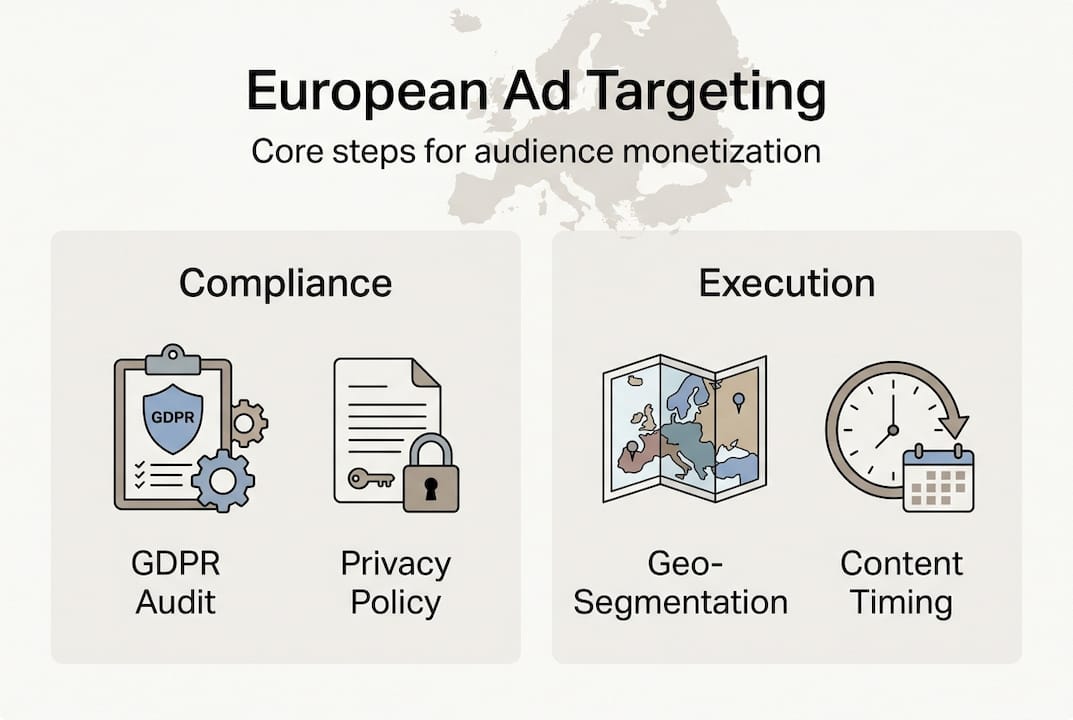
Pro Tip: Run a GDPR compliance scan using tools like OneTrust or Cookiebot before activating European ad targeting. These scanners identify cookies and trackers that fire before consent, helping you fix violations before regulators notice.
Executing effective ad targeting on AdSense and Adsterra
Once your compliance infrastructure is in place, you can focus on optimizing ad placements and targeting strategies for European audiences. AdSense and Adsterra take fundamentally different approaches to geo-targeting, and understanding these differences helps you maximize revenue from both platforms.
AdSense automatically serves ads based on visitor location using IP address detection. Publishers cannot manually select which countries see specific ad units, but the platform prioritizes compliance over manual geo-filtering by respecting consent signals and regional regulations. This hands-off approach works well for creators who want simple setup, but it limits control over which European regions generate the most revenue. AdSense excels with Tier 1 European traffic from countries like Germany, Switzerland, and the Netherlands where advertiser demand is high.
Adsterra provides granular control that AdSense lacks. The platform allows geo-segmentation by country, region, and city to optimize placements for specific European visitor segments. You can create separate ad zones for Western versus Eastern European traffic, adjusting formats and bid floors to match regional CPM rates. This flexibility makes Adsterra particularly effective for Tier 2 European countries like Poland, Romania, and Greece where AdSense CPMs tend to be lower.
Here is a step-by-step process for implementing European ad targeting:
- Set up separate ad units for European traffic using geo-segmentation rules in your ad management platform
- Configure your CMP to load ad scripts only after receiving explicit consent from EU visitors
- Create localized content in major European languages to attract native speakers and improve engagement
- Test different ad formats, starting with native ads and display banners before adding more intrusive formats
- Monitor performance for 2-3 weeks, then refine targeting by eliminating low-performing regions
- Implement fallback ad units that serve contextual ads to visitors who decline consent
Content optimization plays a crucial role in attracting quality European traffic. Publishing during European business hours increases the likelihood that your posts appear in feeds when your target audience is active. Translating key articles into German, French, Spanish, and Italian expands your reach across major EU markets. Even simple localization like converting measurements to metric and using European date formats improves user experience and engagement metrics.

Comparing platform capabilities helps you decide where to allocate your European ad inventory:
| Feature | AdSense | Adsterra |
|---|---|---|
| Geo-targeting control | Automatic only | Manual country/region/city selection |
| Tier 1 EU CPM | Higher | Moderate |
| Tier 2 EU CPM | Lower | Higher |
| Ad formats | Display, native, video | Display, native, popunder, push |
| Consent handling | Built-in | Requires CMP integration |
| Payment threshold | $100 | $5 |
Pro Tip: Allocate 70% of your premium European ad inventory to AdSense for Tier 1 traffic and 70% to Adsterra for Tier 2 traffic. This hybrid approach captures the best CPM rates from each platform's strengths.
Common challenges and how to verify your targeting success
Even with proper preparation, publishers encounter obstacles when monetizing European audiences. Recognizing these challenges early and implementing verification processes ensures your targeting strategy delivers consistent results.
Consent fatigue represents one of the biggest hurdles for European monetization. Visitors who see cookie banners on every site they visit increasingly click reject or simply close the banner without making a choice. When users decline consent, you can only serve contextual ads that generate significantly lower revenue. Some publishers report consent rates below 40% in certain EU countries, cutting potential ad earnings in half. Combat this by designing clear, concise consent notices that explain the value exchange: free content in return for ad personalization.
Personalized ad restrictions for minors create complications if your content attracts younger audiences. The Digital Services Act enforcement began in 2024, and platforms now face substantial fines for violations. If analytics show a significant portion of your European traffic comes from users under 18, you must implement age verification or default to non-personalized ad formats. Contextual targeting based on page content rather than user data provides a compliant alternative, though CPM rates typically drop 30-50% compared to personalized ads.
Monitoring your targeting effectiveness requires analyzing multiple data points:
- Geographic revenue reports showing CPM rates by country and region
- Consent acceptance rates broken down by traffic source and device type
- Fill rate percentages indicating how often ad requests return paid impressions
- Viewability scores measuring whether ads actually appear in the visitor's viewport
- Click-through rates comparing European performance to other regions
Adsterra's dashboard provides detailed geo-statistics that help identify which European countries drive the most revenue. Filter reports by date range to spot seasonal trends, as European traffic patterns shift dramatically during summer holidays and winter breaks. AdSense offers similar geographic breakdowns through the Performance Reports section, though the data updates less frequently than Adsterra's real-time statistics.
Hybrid monetization strategies combining both platforms consistently outperform single-platform approaches for European traffic. Research shows Adsterra outperforms AdSense by approximately 37% on Tier 2 EU traffic, making it the better choice for Eastern and Southern European visitors. Meanwhile, AdSense maintains advantages in Western European markets where premium advertisers concentrate their budgets. Running both platforms simultaneously lets you capture optimal rates across the full European spectrum.
Performance data for hybrid European monetization typically looks like this:
| Metric | AdSense only | Adsterra only | Hybrid approach |
|---|---|---|---|
| Average EU CPM | $2.80 | $3.20 | $3.65 |
| Tier 1 CPM | $4.50 | $3.10 | $4.50 |
| Tier 2 CPM | $1.80 | $2.90 | $2.85 |
| Fill rate | 87% | 92% | 94% |
| Monthly revenue (10k EU visitors) | $280 | $320 | $365 |
Continuous optimization based on performance data separates successful European monetization from mediocre results. Review your geographic reports monthly to identify underperforming regions. If certain countries consistently generate low CPMs and poor engagement, consider excluding them from personalized ad targeting or reducing ad density on those visits. Conversely, double down on high-performing regions by creating more content that appeals to those audiences and experimenting with premium ad formats.
Explore terms of use for effective ad monetization
Understanding platform policies and legal requirements forms the foundation of sustainable ad revenue. The terms of use page provides detailed information about user rights, publisher obligations, and compliance standards that affect how you monetize European traffic.
Reviewing these terms helps you avoid common policy violations that can result in account suspension or revenue clawbacks. Many publishers overlook specific clauses about ad placement restrictions, prohibited content categories, and data handling requirements until they face enforcement actions. Combining the targeting strategies outlined in this guide with a thorough understanding of platform terms ensures you build a compliant, profitable monetization system that serves European audiences effectively.
FAQ
How do I comply with GDPR when targeting European visitors?
Use a consent management platform that supports IAB Transparency and Consent Framework version 2.3 to collect explicit permission before loading personalized ad scripts. Your CMP should block all tracking cookies until the visitor actively consents, and you must provide clear information about what data you collect and how advertisers use it. Implement a privacy policy that specifically addresses ad cookies and give users the ability to withdraw consent at any time.
Can I target personalized ads to minors in Europe?
No, the European Union's Digital Services Act explicitly prohibits personalized advertising targeted at users under 18 years old. You must implement age verification mechanisms like age gates or date of birth entry forms to identify minor visitors. For users who identify as minors or decline to verify their age, serve only contextual ads based on page content rather than personal data.
Is it better to use AdSense or Adsterra for European traffic?
Adsterra provides superior geo-targeting capabilities and higher CPM rates on Tier 2 European traffic from countries like Poland, Romania, and Greece. AdSense performs better with Tier 1 Western European visitors from Germany, France, and the UK. The optimal strategy combines both platforms, allocating premium inventory to the platform that performs best for each specific European region.
How long does it take to see results from European ad targeting?
Most publishers notice measurable changes in CPM rates and revenue within 2-3 weeks of implementing geo-targeted European ad strategies. However, achieving optimal performance requires at least 60-90 days of data collection and iterative refinement. Monitor your geographic reports weekly during the first month to identify quick wins, then shift to monthly optimization cycles as your targeting stabilizes.
What consent acceptance rate should I expect from European visitors?
Consent acceptance rates for European traffic typically range from 35% to 60% depending on your content niche, audience demographics, and consent notice design. News and entertainment sites often see lower acceptance rates around 40%, while educational and professional content sites achieve rates closer to 55%. Focus on creating clear, concise consent messages that emphasize the value exchange rather than using pre-checked boxes or deceptive design patterns that violate GDPR.