
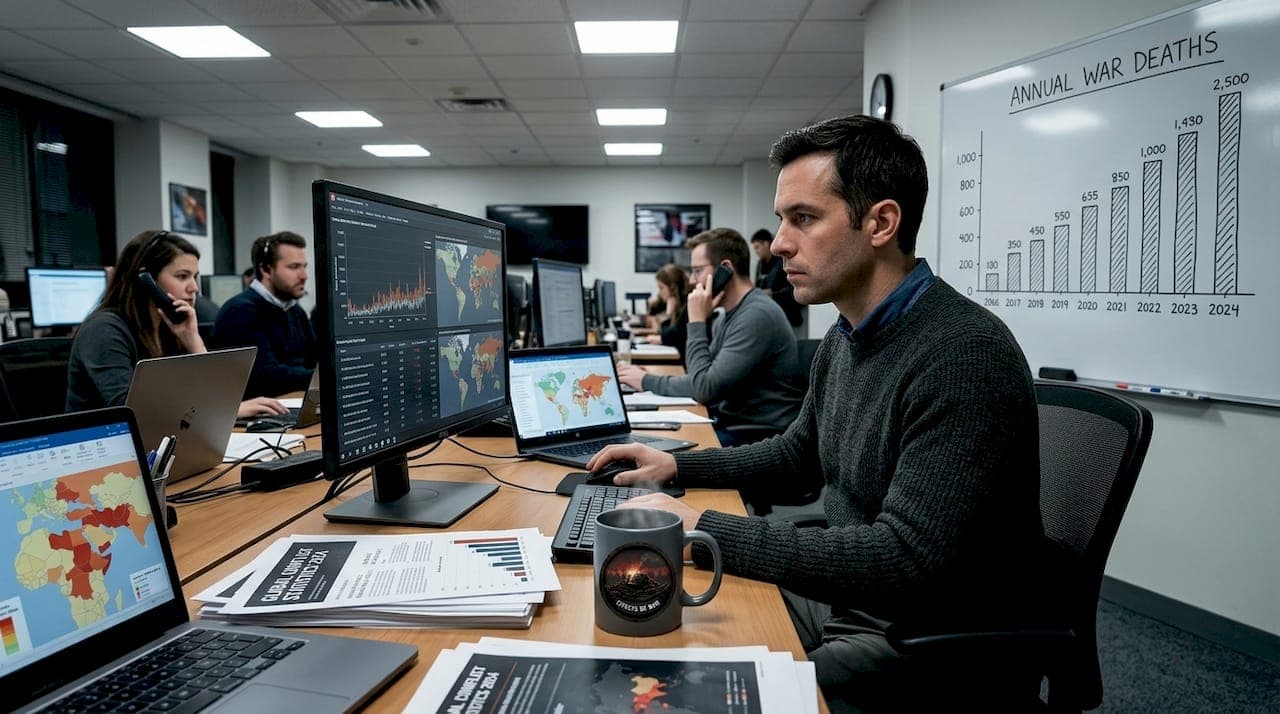
Understanding the true scale of war requires more than headlines. Measuring conflict statistics involves complex methodologies, varying definitions, and incomplete records that challenge even expert researchers. From historical death tolls reaching tens of millions to modern conflicts tracked by sophisticated databases, war statistics reveal patterns that shape international policy and humanitarian response. This article examines the criteria organizations use to classify wars, explores major historical and contemporary conflicts through data, and addresses the challenges inherent in measuring human tragedy through numbers.
Table of Contents
- Key takeaways
- Understanding how wars are defined and classified
- Historical war death tolls: The scale of major conflicts
- Trends in recent and ongoing conflicts
- Challenges and insights in measuring war statistics
- Explore in-depth effects of war
- Frequently asked questions
Key Takeaways
| Point | Details |
|---|---|
| War definitions thresholds | UCDP defines armed conflict as 25 or more battle deaths per year while war requires at least 1,000 deaths annually, and four conflict types shape how data are categorized. |
| Data interpretation cautions | A conflict that kills 900 people a year may appear in armed conflict datasets but not in war tallies, underscoring the need to check the source type and threshold. |
| Historic toll variability | WWII caused an estimated 70 to 85 million deaths, with wide ranges reflecting record gaps, attribution disputes, and differing civilian casualty methodologies. |
| Recent conflict trends | In 2023 there were 59 state based conflicts with about 154,000 battle deaths, and in 2024 the count rose to 61 conflicts with roughly 129,000 deaths, with Africa bearing the heaviest current burden. |
Understanding how wars are defined and classified
Before comparing war statistics, you need to understand how researchers distinguish armed conflicts from full-scale wars. The Uppsala Conflict Data Program (UCDP) defines armed conflict as contested incompatibility with 25+ battle deaths per year, while war requires 1,000+ deaths annually. These thresholds provide consistent criteria for tracking violence across decades and continents.
The Correlates of War project uses similar death thresholds but adds detailed actor-type classifications. Both datasets categorize conflicts into four main types:
- Inter-state wars between recognized governments
- Intra-state wars within a single country, including civil wars
- Extra-state wars between a state and non-state territory
- Non-state conflicts between armed groups without government involvement
These war definitions and classifications directly impact statistical collection and interpretation. A conflict killing 900 people annually appears in armed conflict databases but not war datasets, creating apparent discrepancies. Understanding these boundaries helps you evaluate claims about increasing or decreasing global violence with proper context.
Pro Tip: When reading war statistics, always check which death threshold and conflict type the source uses. A study claiming declining wars might exclude armed conflicts under 1,000 deaths, potentially missing significant violence trends.
Historical war death tolls: The scale of major conflicts
World War II stands as history's deadliest war, with estimates ranging from 70 to 85 million deaths between 1939 and 1945. This staggering toll includes both military casualties and civilian deaths from combat, genocide, famine, and disease. The wide estimate range reflects challenges in counting deaths across multiple continents with incomplete wartime records.
Other major historical conflicts demonstrate the devastating scale of 20th-century warfare:
| Conflict | Time Period | Estimated Deaths |
|---|---|---|
| World War II | 1939-1945 | 70-85 million |
| World War I | 1914-1918 | 15-22 million |
| Chinese Civil War | 1927-1949 | 8-12 million |
| Russian Civil War | 1917-1922 | 5-9 million |
| Vietnam War | 1955-1975 | 1.3-4.3 million |
These figures reveal how demographic effects of major wars reshape entire societies. The variation in estimates stems from three main factors: incomplete government records during wartime chaos, disagreement over which deaths to attribute directly to conflict, and differing methodologies for estimating civilian casualties in occupied territories.
Comparing historical wars requires caution beyond just death counts. Population-adjusted figures show different patterns than raw totals. The Mongol conquests of the 13th century killed an estimated 30-40 million people, representing a far larger percentage of global population than World War II despite lower absolute numbers.
Pro Tip: When evaluating historical war statistics, look for sources that provide estimate ranges rather than single figures. Ranges acknowledge data uncertainty and give you a more honest picture of what researchers actually know.
Trends in recent and ongoing conflicts
Global conflict patterns have shifted dramatically in recent years. In 2024, 61 state-based conflicts erupted worldwide, resulting in approximately 129,000 battle deaths. This follows 2023's record of 59 conflicts with 154,000 deaths, marking the highest annual toll since systematic tracking began in 1946.

Africa bears the heaviest current burden, with multiple nations experiencing simultaneous conflicts. The continent's rising casualty rates reflect both increased conflict frequency and intensity, particularly in the Sahel region and East Africa. Infrastructure damage in African conflicts compounds humanitarian crises, displacing millions and disrupting essential services.
Recent conflict trends reveal several concerning patterns:
- Post-2010 surge in both conflict numbers and battle deaths
- Increasing involvement of non-state armed groups
- Longer average conflict duration compared to Cold War era
- Higher civilian casualty ratios in urban warfare settings
- Proliferation of conflicts with multiple overlapping armed groups
Machine learning models analyzing historical patterns and current trajectories offer sobering forecasts. Researchers predict Ukraine, Palestine/Israel, and Sudan will experience the highest battle deaths in 2026, with each conflict potentially exceeding 10,000 casualties. These war forecasting models incorporate factors like previous violence levels, political instability indicators, and regional conflict spillover risks.
The data shows we're living through a period of elevated global conflict intensity. Understanding these trends helps policymakers allocate humanitarian resources and guides conflict prevention efforts toward the most vulnerable regions.
Pro Tip: Track annual UCDP reports to monitor how forecasts compare with actual outcomes. This practice helps you develop intuition for which conflict indicators prove most reliable for predicting escalation.
Challenges and insights in measuring war statistics
Measuring war deaths involves far more complexity than counting bodies. Incomplete records and differing methodologies create substantial uncertainty in historical and contemporary estimates. Active war zones rarely maintain accurate casualty registries, and governments may deliberately obscure or inflate figures for political purposes.
The distinction between direct and indirect deaths fundamentally shapes war statistics. Direct battle deaths include combatants and civilians killed by violence. Indirect deaths from war-induced famine, disease, and collapsed healthcare systems often exceed direct casualties but receive inconsistent inclusion across datasets. This definitional choice dramatically affects total war death estimates.
Methodological debates extend to long-term violence trends. Some researchers argue violence has declined per capita over centuries, while critics question these conclusions when accounting for population scaling effects and data quality issues in historical records. The debate highlights how statistical framing influences our understanding of human progress.
Key measurement challenges include:
- Missing data from inaccessible conflict zones
- Disagreement over attributing deaths to specific conflicts versus general instability
- Time lag between events and verified casualty counts
- Political incentives distorting official government figures
- Difficulty separating conflict deaths from background mortality rates
Researchers address these issues through triangulation, comparing multiple sources and applying statistical uncertainty bands. Modern conflict tracking increasingly uses satellite imagery, social media analysis, and machine learning to supplement traditional reporting. These methods improve real-time accuracy but introduce new biases around digital access and surveillance coverage.
"The numbers we cite represent our best estimates given available evidence, but every figure carries substantial uncertainty. Acknowledging this uncertainty is crucial for honest scholarship and policy-making." - Uppsala Conflict Data Program methodology notes
Understanding these limitations doesn't invalidate war statistics but contextualizes them appropriately. The psychology behind war statistics shows how precise-sounding numbers create false certainty, while cultural factors in conflict reporting influence which deaths receive documentation and attention.
Explore in-depth effects of war
War statistics tell only part of the story. Beyond death tolls, conflicts reshape economies, destroy infrastructure, and alter societies for generations. Our site provides comprehensive analysis of these multifaceted impacts, helping you understand the full scope of warfare's consequences.
Dive deeper into how conflicts affect economic systems and development, from immediate destruction to long-term growth impacts. Explore detailed assessments of war effects on infrastructure, including transportation networks, utilities, and essential services. Review our terms of use for war data to understand sourcing and analytical frameworks behind the statistics.
Frequently asked questions
What is the difference between an armed conflict and a war?
Armed conflict involves 25 or more battle deaths in a calendar year according to UCDP criteria. War requires 1,000 or more deaths annually, representing a higher intensity threshold. This distinction helps researchers track violence across different scales and identify escalation patterns before conflicts reach war-level intensity.
Why do estimates of war death tolls vary so much?
Variations arise from incomplete records in active conflict zones, differing definitions of conflict-related deaths, and methodological choices about including indirect casualties. Some estimates count only direct battle deaths while others incorporate famine and disease. Historical conflicts face additional challenges from destroyed archives and politically motivated record-keeping, creating estimate ranges that span millions of deaths.
How are modern conflict death forecasts made?
Forecasts use machine learning algorithms trained on historical conflict data, analyzing patterns in previous escalations and de-escalations. Models incorporate variables like prior violence levels, political stability indicators, economic conditions, and regional conflict spillover. Conflict forecasting models generate probabilistic predictions with uncertainty ranges rather than single point estimates, acknowledging inherent unpredictability in human conflict.
Which regions face the most conflicts today?
Africa currently experiences the highest number of state-based conflicts and battle deaths globally, particularly concentrated in the Sahel and East Africa. The Middle East and parts of Asia also face significant ongoing violence. African conflict regions show complex patterns of overlapping armed groups, resource competition, and climate-related pressures that fuel instability.
Do war statistics include civilian deaths?
Battle death statistics traditionally focus on deaths directly caused by combat violence, including both combatants and civilians killed in fighting. Many datasets exclude indirect deaths from war-induced famine, disease, and healthcare collapse, though some researchers argue these should be included for complete accounting. Always check a dataset's methodology to understand which deaths are counted and which are excluded from the reported figures.