

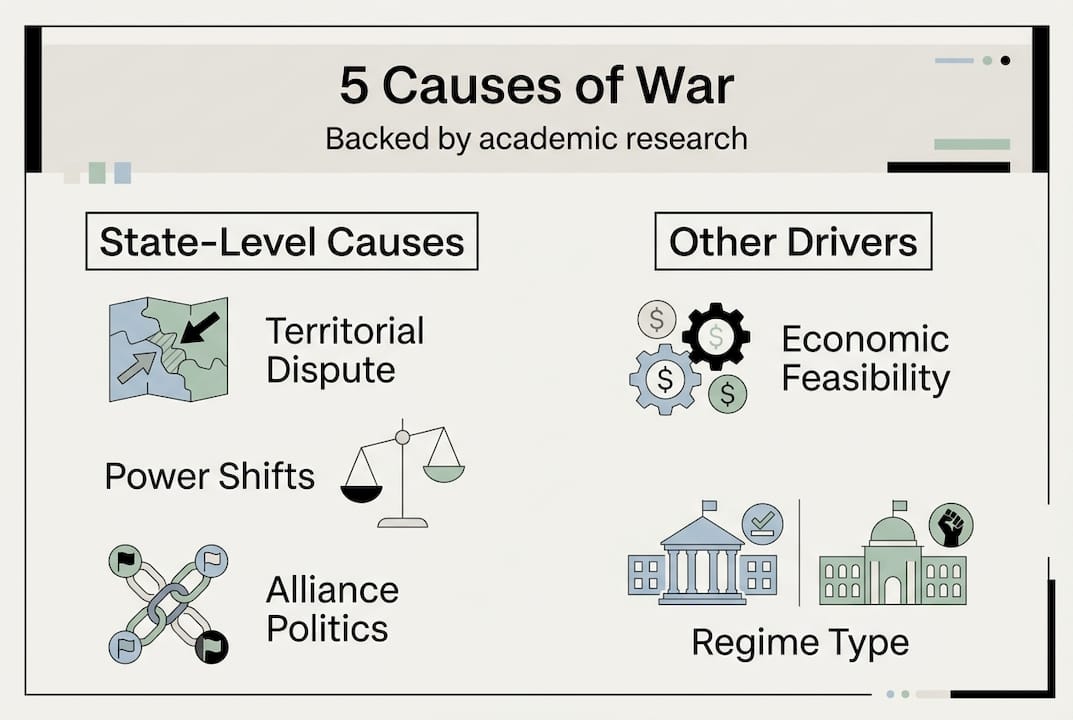
Most people believe wars erupt from simple causes like greed, hatred, or revenge. The reality is far more complex. Wars result from intricate combinations of territorial disputes, power politics, rationalist calculations, economic feasibility, and domestic political structures. Understanding these causes matters for students of international relations and political science who want to grasp why nations repeatedly choose conflict over peace. This article breaks down the systemic, dyadic, domestic, and individual factors that drive states toward war, exploring both theoretical frameworks and empirical evidence that explain when and why violence becomes the chosen path.
Table of Contents
- Key takeaways
- The foundation: territorial disputes and power politics
- Rationalist causes: uncertainty, commitment, and indivisibilities
- Civil wars: feasibility over grievances
- Political regimes and trade: democracy, authoritarianism, and economic ties
- Explore effects of war and related insights
- Frequently asked questions
Key Takeaways
| Point | Details |
|---|---|
| Territorial disputes drive war | Territorial claims raise conflict potential by creating conditions for violent confrontation. |
| Power politics escalate tensions | Alliance formations and arms buildups heighten perceived threats and spur reciprocal militarization. |
| Information and uncertainty | Private information and uncertainty lead states to misrepresent capabilities or resolve, preventing peaceful settlements. |
| Economic feasibility matters | The cost and feasibility of sustaining civil war influence whether leaders pursue conflict over bargaining. |
| Democratic versus authoritarian tendencies | Democracies rarely initiate preventive wars while authoritarians are more prone to preemptive or coercive conflict. |
The foundation: territorial disputes and power politics
Territorial disputes ignite the underlying conflict potential that leads states toward war. When nations claim the same land, resources, or strategic positions, they create the foundation for violent confrontation. These disputes don't automatically cause war, but they establish the conditions where other factors can push countries over the edge into armed conflict.
Power politics intensifies these territorial tensions through alliance formations and competitive arms buildups. When one state strengthens its military capabilities or forms alliances with other powers, rival nations perceive increased threats to their security. This perception triggers reciprocal military investments, creating spirals of mistrust and preparation for potential conflict. Arms races emerge as each side attempts to maintain or gain strategic advantage, making war escalation more likely through miscalculation or preemptive strikes.
Historical patterns reveal how these dynamics unfold in practice. Germany's military buildup before World War I exemplifies how arms competition combined with alliance systems transformed European territorial tensions into continental war. Similarly, the Kashmir dispute between India and Pakistan demonstrates how persistent territorial claims fuel recurring crises and military confrontations spanning decades. These rivalries create environments where minor incidents can trigger major wars because the underlying conditions favor violent resolution over peaceful negotiation.
Pro Tip: Territorial disputes become especially dangerous when combined with regime changes, economic crises, or shifts in relative power between rivals. These multiplier effects explain why some disputes remain frozen for years while others suddenly explode into violence.
"Territory matters because it represents tangible value, national identity, and strategic position. States fight hardest for what they can see, measure, and defend."
Misperceptions amplify the dangers inherent in territorial disputes and power politics. Leaders often overestimate their own capabilities while underestimating adversaries, creating false confidence in military victory. They may misread defensive preparations as offensive threats, triggering preemptive actions that neither side originally wanted. These cognitive biases interact with the structural conditions of territorial disputes and arms races to produce wars that rational calculation might have prevented.
Rationalist causes: uncertainty, commitment, and indivisibilities
The bargaining model identifies three rationalist causes that explain why states fail to reach peaceful settlements despite war's obvious costs. These factors reveal how rational actors can end up fighting even when negotiated solutions would leave both sides better off. Understanding these mechanisms helps explain the puzzle of why wars happen when peace offers mutual benefits.
Private information and uncertainty about capabilities or intentions create the first rationalist pathway to war. States possess incentives to misrepresent their strength, resolve, or willingness to compromise during negotiations. When both sides inflate their positions or hide weaknesses, they may reach incompatible demands that make peaceful settlement impossible. Neither side knows whether the opponent is bluffing or genuinely committed to their stated position. This uncertainty can lead to war as a costly but informative signal that reveals true capabilities and intentions.

Commitment problems arise when states cannot credibly promise to honor future agreements. Even if both sides prefer a negotiated settlement today, one party may fear that the other will exploit the peace to grow stronger and renegotiate terms later from a position of advantage. This problem becomes acute when dealing with rising powers or situations where the distribution of power is shifting. The declining state faces a choice between accepting unfavorable terms now or fighting while it still has relative advantage. Without mechanisms to guarantee compliance with negotiated terms, preventive war becomes rational for the declining power.
Indivisible issues present the third rationalist cause, though empirical evidence suggests they rarely drive real conflicts. Some goods theoretically cannot be divided between parties, such as religious holy sites or symbolic territories. However, creative solutions like time sharing, international administration, or side payments usually allow even apparently indivisible goods to be split. The more significant problem is that symbolic or ideological issues become linked to domestic political survival, making leaders unwilling to compromise even when the underlying good could be divided.
Pro Tip: Most wars attributed to indivisibilities actually stem from commitment problems or uncertainty. Leaders invoke indivisibility to justify conflicts driven by other rationalist factors or domestic political pressures.
These rationalist explanations illuminate why bargaining theory predicts both war and peace. When information is complete, commitments are credible, and issues are divisible, states should always find negotiated settlements preferable to costly wars. Real world conflicts demonstrate these dynamics repeatedly. The 2003 Iraq War reflected uncertainty about weapons programs and inability to credibly commit to disarmament verification. World War I showed how shifting power balances and alliance commitments created unsolvable commitment problems among European powers.
Civil wars: feasibility over grievances
Civil wars differ fundamentally from interstate conflicts in their causes and dynamics. While territorial disputes and power politics drive wars between states, internal conflicts follow different patterns rooted in economic opportunities rather than political grievances. This distinction matters for understanding why some countries experience civil wars while others with similar grievance levels remain peaceful.
Economic opportunities for rebels predict civil war onset more accurately than inequality, political rights, or ethnic tensions. Feasibility focuses on whether insurgents can finance rebellion through natural resource extraction, diaspora funding, or external support. Countries with easily exploitable resources like diamonds, timber, or drugs face higher civil war risk because rebels can sustain military operations through resource control. Geographic factors like mountainous terrain or remote forests increase feasibility by providing safe havens where government forces struggle to operate effectively.
Grievance theories propose that civil wars erupt from inequality, ethnic discrimination, or political repression. Empirical testing reveals weak relationships between these factors and conflict onset. Many highly unequal societies remain peaceful while relatively equal countries experience civil wars. Political rights show similarly inconsistent patterns, with both highly repressive and partially democratic regimes facing rebellion. These findings challenge conventional wisdom that addressing grievances prevents civil war.
The feasibility framework explains these patterns by recognizing that grievances exist widely but rebellions require resources, organization, and opportunity. Potential rebels face collective action problems in mobilizing supporters, securing weapons, and coordinating operations against government forces. Economic opportunities solve these problems by providing revenue streams that fund recruitment, arms purchases, and operational expenses. Civil war dynamics therefore depend more on rebel financing capabilities than on the depth of popular discontent.
"Rebellion is not caused by grievance but by the feasibility of organizing and sustaining insurgent groups. Greed may not motivate rebels, but economic opportunities enable them."
Policy implications follow directly from this understanding. International efforts to prevent civil wars should focus on reducing rebel financing opportunities through resource certification schemes, financial monitoring, and border controls that limit arms flows. Addressing underlying grievances remains important for justice and development but proves less effective at preventing conflict onset. Peacebuilding strategies must recognize that ending civil wars requires eliminating economic incentives and opportunities for violence, not just negotiating political settlements.
Political regimes and trade: democracy, authoritarianism, and economic ties
Domestic political structures shape how states approach decisions about war and peace. The distinction between democratic and authoritarian regimes produces systematically different patterns in conflict initiation, particularly regarding preventive wars against rising challengers. These regime effects interact with economic relationships to create complex patterns of cooperation and conflict in the international system.
No democracy has initiated preventive war against a rising challenger, while authoritarian states frequently choose this path. Democratic institutions create constraints that make preventive war politically costly for leaders. Elected officials must justify military action to voters who bear the costs through casualties and economic disruption. Opposition parties scrutinize war decisions and can punish leaders who initiate unsuccessful conflicts. Public debate and media coverage expose the uncertainties and risks inherent in preventive strikes, making democratic publics skeptical of wars fought over potential future threats rather than immediate dangers.
Authoritarian leaders face different incentive structures that encourage preventive war initiation. Without electoral accountability, dictators can launch wars based on regime survival calculations rather than national interest. Preventive wars against rising powers can demonstrate strength, distract from domestic problems, or eliminate future threats to the regime. The absence of institutional checks allows authoritarian leaders to act on worst case assumptions about adversary intentions without facing the political costs that constrain democratic leaders. This explains why power transitions more often lead to war when declining powers have authoritarian governments.
Trade relationships create economic interdependence that influences conflict probability through multiple mechanisms. Bilateral trade reduces war probability by increasing the opportunity costs of conflict. When two countries trade extensively with each other, war disrupts valuable economic relationships and imposes costs on domestic constituencies who benefit from trade. These groups lobby against conflict, creating domestic political pressures for peaceful dispute resolution.
Multilateral trade openness produces opposite effects by reducing bilateral dependence. Countries with diversified trade relationships can more easily substitute alternative partners if conflict disrupts trade with any single country. This reduces the opportunity costs of bilateral conflict and weakens the peace through trade mechanism. Empirical evidence shows that while bilateral trade promotes peace, multilateral openness can increase war risk by making states less dependent on any particular trading partner.
| Factor | Effect on War Risk | Mechanism |
|---|---|---|
| Democratic regime | Reduces preventive war | Electoral accountability and institutional constraints |
| Authoritarian regime | Increases preventive war | Regime survival incentives and lack of checks |
| Bilateral trade | Reduces conflict | Increases opportunity costs through mutual dependence |
| Multilateral openness | May increase conflict | Reduces bilateral dependence and opportunity costs |
These findings carry important implications for trade and conflict relations and political regime impacts. Promoting peace requires both democratic governance and trade policies that encourage bilateral rather than purely multilateral relationships. Regional trade agreements may prove more effective at reducing conflict than global trade liberalization because they increase bilateral dependence among member states.
Explore effects of war and related insights
Understanding why wars start provides essential foundation, but grasping their consequences completes the picture. Students of international relations benefit from connecting causal theories with empirical evidence about war's impacts across economic, social, and political dimensions. The website offers comprehensive resources exploring how conflicts reshape societies, economies, and international systems.
Detailed analyses examine war's effects on infrastructure, demographics, psychology, and long term development trajectories. These resources complement theoretical understanding of war causes by showing concrete consequences that flow from conflict decisions. Exploring both causes and effects helps students develop nuanced perspectives on why preventing war matters and how post conflict reconstruction addresses damage. The effects of war overview provides starting points for deeper investigation, while specialized sections like war impact on infrastructure offer focused analysis of specific consequence categories. Connecting theory with real world outcomes strengthens analytical skills essential for careers in international relations, policy analysis, or conflict resolution.
Frequently asked questions
What is the primary reason wars start?
Territorial disputes provide the underlying cause for most interstate wars, creating conflict potential that other factors activate. Power politics through alliances and arms races then escalate these disputes into actual violence. No single factor alone causes war, but territorial issues combined with security competition create the most dangerous conditions for conflict outbreak.
How do economic factors influence civil wars?
Economic feasibility drives civil war onset more than political grievances or inequality. Rebels need financing through natural resources, diaspora support, or external funding to sustain insurgencies against government forces. Countries with easily exploitable resources and terrain favoring insurgents face higher civil war risk regardless of grievance levels. This explains why addressing inequality alone rarely prevents internal conflicts.
Why are democracies less likely to start preventive wars?
Democratic institutions create accountability mechanisms that constrain leaders from initiating preventive wars against rising powers. Elected officials must justify conflicts to voters who bear the costs, while opposition parties scrutinize war decisions and media coverage exposes uncertainties. These checks make democratic publics skeptical of wars fought over potential future threats rather than immediate dangers, leading to systematic avoidance of preventive conflicts.
Can trade both increase and decrease war risk?
Bilateral trade reduces war probability by creating mutual economic dependence that raises conflict costs for both parties. However, multilateral trade openness can increase war risk by allowing states to substitute alternative partners if conflict disrupts trade with any single country. This reduces bilateral dependence and weakens the opportunity costs that normally deter conflict. The net effect depends on whether trade relationships create concentrated bilateral ties or diversified multilateral connections.
Do rationalist theories fully explain war causes?
Rationalist explanations identify necessary conditions for war but don't capture all causal mechanisms. Uncertainty, commitment problems, and indivisibilities explain why rational actors sometimes fight despite war's costs. However, these theories struggle with psychological biases, domestic political pressures, and ideological factors that also drive conflict decisions. Comprehensive understanding requires combining rationalist frameworks with insights about human cognition, political institutions, and cultural factors that shape how leaders perceive threats and opportunities.